Direct transfer of severe stroke patients to designated hospitals
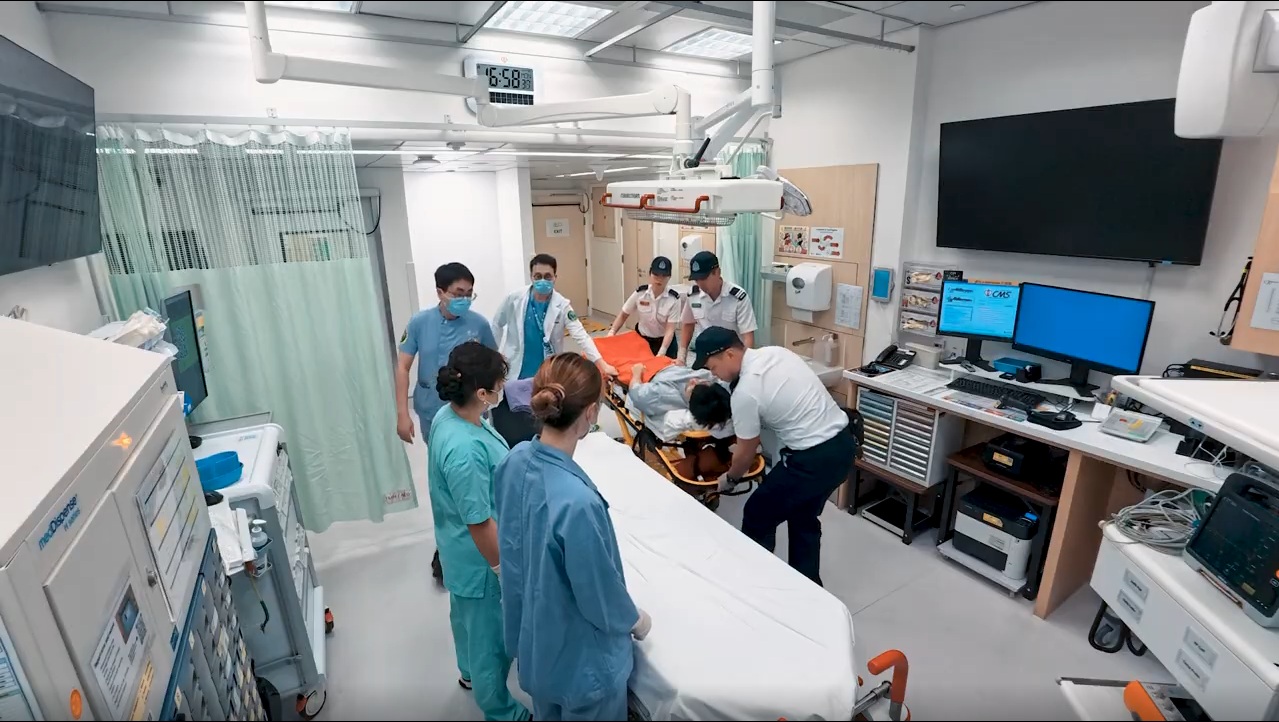
In stroke treatment, every second counts. Seizing the critical time for admission can reduce brain damage and the risk of long-term disability. The Hospital Authority (HA) and the Fire Services Department (FSD) have launched the Pre-hospital Stroke Diversion Scheme (Primary Diversion Scheme). Under this scheme, ambulance personnel utilises standardised medical evaluations to determine whether the patient exhibits suspected acute stroke symptoms. Patients preliminarily assessed by ambulance personnel as having suspected large vessel occlusion (LVO) will be directly conveyed to designated HA hospitals within the service catchment areas for early treatment. The scheme has been rolled out in the New Territories East Cluster (NTEC) and New Territories West Cluster (NTWC), and will extend to other clusters in an orderly manner.
Evaluate patients with stroke assessment scale
As early as 2021, the HA and FSD introduced a territorywide Pre-hospital Stroke Notification mechanism. If a patient exhibits suspected acute stroke symptom, ambulance personnel will immediately alert the accident and emergency (A&E) department of the public hospital concerned, enabling the hospital's stroke team to make advanced preparations for faster examination and treatment. Dr Chris Tsang, HA's Chief Manager (Integrated Clinical Services), notes that the Primary Diversion Scheme utilises a standardised medical evaluation with the use of an enhanced stroke assessment scale. "To ensure the smooth implementation of the Primary Diversion Scheme, HA and the FSD have conducted multiple drills in advance, allowing ambulance personnel to effectively score the severity of a patient's condition based on symptoms like facial drooping or arm weakness. The scale has a maximum of nine points, with higher scores indicating a greater likelihood of LVO. Patients preliminarily assessed as having suspected LVO will be directly transported to designated hospitals."
The scheme was introduced in last December in the NTEC and NTWC. Patients from Sha Tin, Tai Po, and North districts suspected of having LVO will be taken to Prince of Wales Hospital, while those from Tuen Mun and Yuen Long districts will be sent to Tuen Mun Hospital, to receive appropriate treatment services according to their clinical condition. As of 1 March this year, 52 patients had been transported under the scheme. Among them, 23 patients diagnosed with acute ischemic stroke received treatments. For stroke patients in other clusters, the ambulance personnel will continue to swiftly convey patients to the public hospital's A&E department in accordance with the established Pre-hospital Stroke Notification mechanism.
Early preparation enhances treatment outcomes
"The scheme facilitates faster identification, notification and transport of suspected LVO patients with activation of the multidisciplinary stroke teams, including A&E, neurology, neurosurgery and radiology teams, to coordinate manpower and prepare facilities such as angiography and operating theatres in advance. Upon arrival, the patients are able to receive examination and treatment efficiently with enhanced clinical outcomes," Dr Tsang adds.
The scheme will extend to the Hong Kong and Kowloon clusters in an orderly manner through a phased approach. The HA also plans to use artificial intelligence to accelerate the identification of stroke types and severity. Leveraging the acute stroke proforma within the Clinical Management System, it is envisaged to further enhance data collection, monitoring, and quality indicator tracking for continuous quality improvement.
"Most importantly, we should educate the public to recognise stroke symptoms and seek medical help immediately. Members of the public calling the FSD's ambulance service for assistance are also advised to cooperate with the professional assessments and judgments conducted by the ambulance personnel," says Dr Tsang.