‘Green Channel’ admission secures golden hour for stroke treatment
Ms Cheng, in her 20s, experienced a terrifying day in May 2024 when she fell off a horse during practice. “I did not feel unwell initially, but after class, I started vomiting and losing consciousness.” She was admitted to Pok Oi Hospital (POH) by ambulance. Similarly, Mr Cheung, 51, suffered hemiplegia and confusion at work in November 2025, and was sent to Queen Mary Hospital (QMH) by ambulance. Both were diagnosed with stroke.
Ms Cheng and Mr Cheung were admitted via the ‘Green Channel’ at Tuen Mun Hospital (TMH) and QMH respectively. Dr Kelvin Tsoi Lap-kiu, Consultant in Medicine & Geriatrics at TMH, recalls that after initial assessment at POH’s Accident & Emergency (A&E) Department, colleagues suspected Ms Cheng had a stroke and referred her to the New Territories West Cluster Integrated Acute Stroke Care Team. A cerebral angiogram confirmed that she had large vessel occlusion in brainstem. The stroke team notified TMH’s IA thrombectomy team via HA Chat and immediately transferred her to TMH.
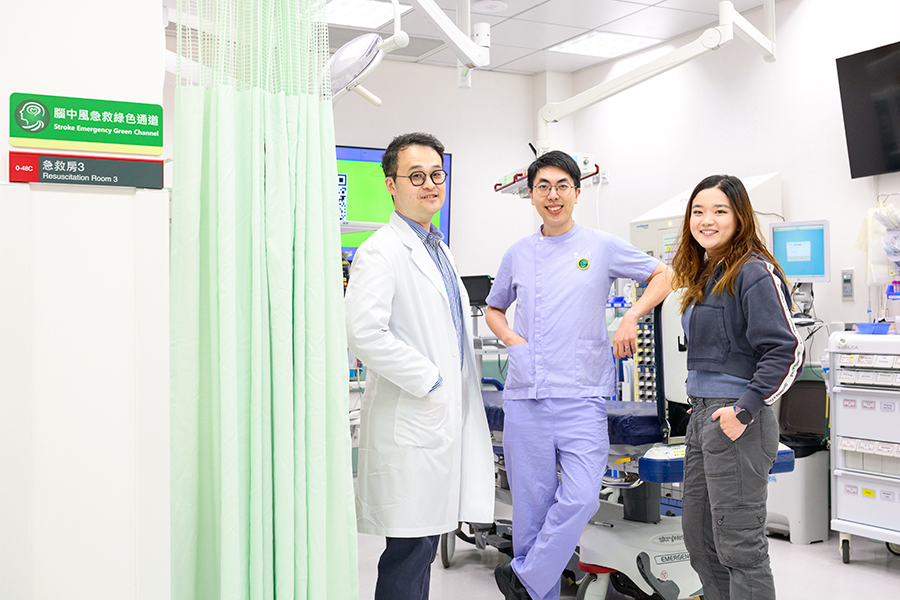 The TMH team performed mechanical thrombectomy on Ms Cheng and removed the blood clot to restore blood flow. Dr Tsoi notes that Ms Cheng had a severe brainstem stroke, who initially required a walker after surgery, but could walk independently after two weeks.
 Both patients’ lives have returned to normal after fighting for their lives. Ms Cheng shares: “I feel like a miracle! Now I drive, exercise, and ride horses as usual. Thank you to the medical team!” Mr Cheung says: “I was back at work a month later after discharge, feeling no difference at all. I know many healthcare staff were involved in my rescue. I am deeply grateful!”
Stroke is the fourth leading cause of death in Hong Kong, with over 2,900 deaths from cerebrovascular disease in 2024. Grasping the golden hour is crucial for treatment. Since the setting up of the ‘Green Channel’, over 1,340 and 730 patients received treatment through the ‘Green Channel’ at TMH and QMH respectively. The median ‘door-to-needle time’ for intravenous thrombolysis and the median ‘door-to-puncture time’ for intra-arterial thrombectomy both meet the national accreditation standards.
Looking ahead, Dr Chi says research indicates that earlier treatment correlates with significantly better recovery outcomes. He hopes to enhance the perfusion scan service to help doctors assess the extent of brain damage, ensuring that eligible patients receive timely treatment. Dr Tsoi hopes to continue to improve the stroke service to save more lives, given two million brain cells die every minute during a stroke. He also wishes to cooperate with Primary Healthcare Commission and non-governmental organisations to raise public awareness of stroke, encouraging people to seek medical consultation as early as possible.
Ms Cheng and Mr Cheung were admitted via the ‘Green Channel’ at Tuen Mun Hospital (TMH) and QMH respectively. Dr Kelvin Tsoi Lap-kiu, Consultant in Medicine & Geriatrics at TMH, recalls that after initial assessment at POH’s Accident & Emergency (A&E) Department, colleagues suspected Ms Cheng had a stroke and referred her to the New Territories West Cluster Integrated Acute Stroke Care Team. A cerebral angiogram confirmed that she had large vessel occlusion in brainstem. The stroke team notified TMH’s IA thrombectomy team via HA Chat and immediately transferred her to TMH.
The TMH team performed mechanical thrombectomy on Ms Cheng and removed the blood clot to restore blood flow. Dr Tsoi notes that Ms Cheng had a severe brainstem stroke, who initially required a walker after surgery, but could walk independently after two weeks.
Patient calls it miracle
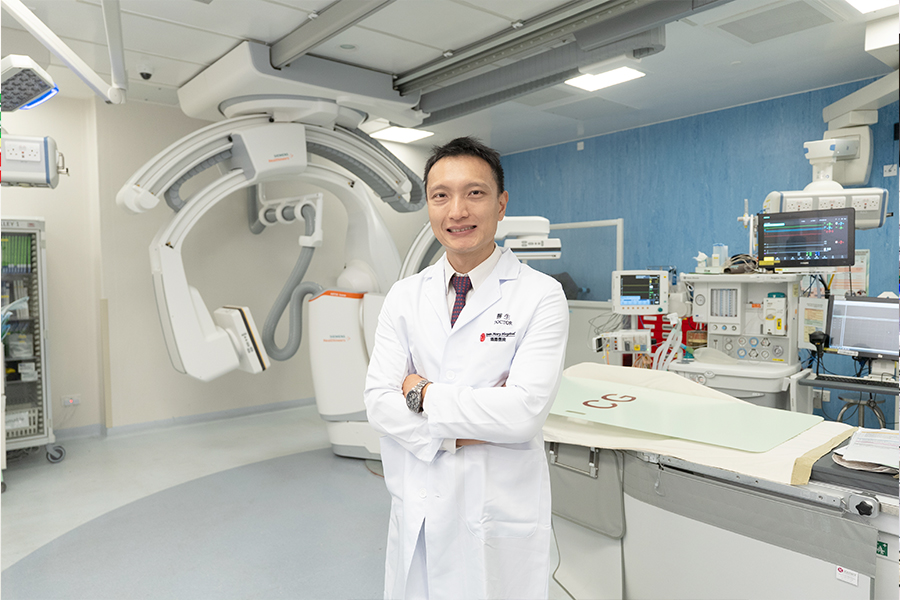
Dr Chi Man-sum, Associate Consultant in the Department of Medicine at QMH, says that Mr Cheung’s condition was moderate to severe upon admission, but fortunately received timely intravenous thrombolysis treatment through the ‘Green Channel’. He also received intra-arterial thrombectomy arranged at the same time and successfully opened up the blocked vessel. The recovery was going smoothly. He explains that since the establishment of the ‘Green Channel’, the multidisciplinary team receives clinical data on suspected stroke patients via HA Chat for advance preparation, enabling timely treatment.
Both patients’ lives have returned to normal after fighting for their lives. Ms Cheng shares: “I feel like a miracle! Now I drive, exercise, and ride horses as usual. Thank you to the medical team!” Mr Cheung says: “I was back at work a month later after discharge, feeling no difference at all. I know many healthcare staff were involved in my rescue. I am deeply grateful!”
Stroke is the fourth leading cause of death in Hong Kong, with over 2,900 deaths from cerebrovascular disease in 2024. Grasping the golden hour is crucial for treatment. Since the setting up of the ‘Green Channel’, over 1,340 and 730 patients received treatment through the ‘Green Channel’ at TMH and QMH respectively. The median ‘door-to-needle time’ for intravenous thrombolysis and the median ‘door-to-puncture time’ for intra-arterial thrombectomy both meet the national accreditation standards.
Looking ahead, Dr Chi says research indicates that earlier treatment correlates with significantly better recovery outcomes. He hopes to enhance the perfusion scan service to help doctors assess the extent of brain damage, ensuring that eligible patients receive timely treatment. Dr Tsoi hopes to continue to improve the stroke service to save more lives, given two million brain cells die every minute during a stroke. He also wishes to cooperate with Primary Healthcare Commission and non-governmental organisations to raise public awareness of stroke, encouraging people to seek medical consultation as early as possible.