Deepening bilateral exchanges for mutual benefit in healthcare talents
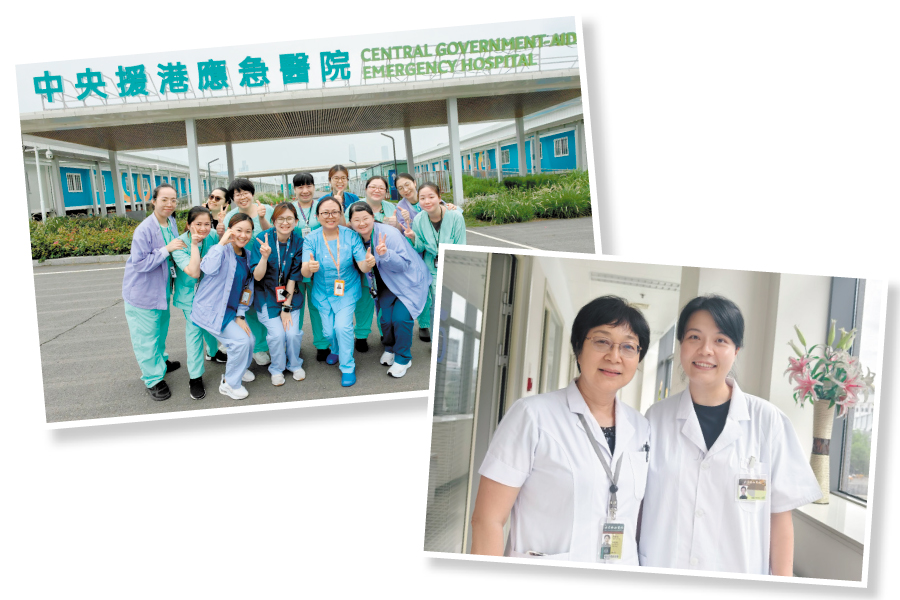 Under the Greater Bay Area (GBA) Healthcare Talents Visiting Programmes, the second batch of GBA healthcare professionals has arrived in Hong Kong. In view of the successful experience of the programme, exchanges with those in other Mainland cities covering more disciplines were raised in the Policy Address. In this edition, we have doctors from Shanghai and Hong Kong to talk about their experiences in Hong Kong and Beijing exchanges respectively.
Looking forward to joint clinical research
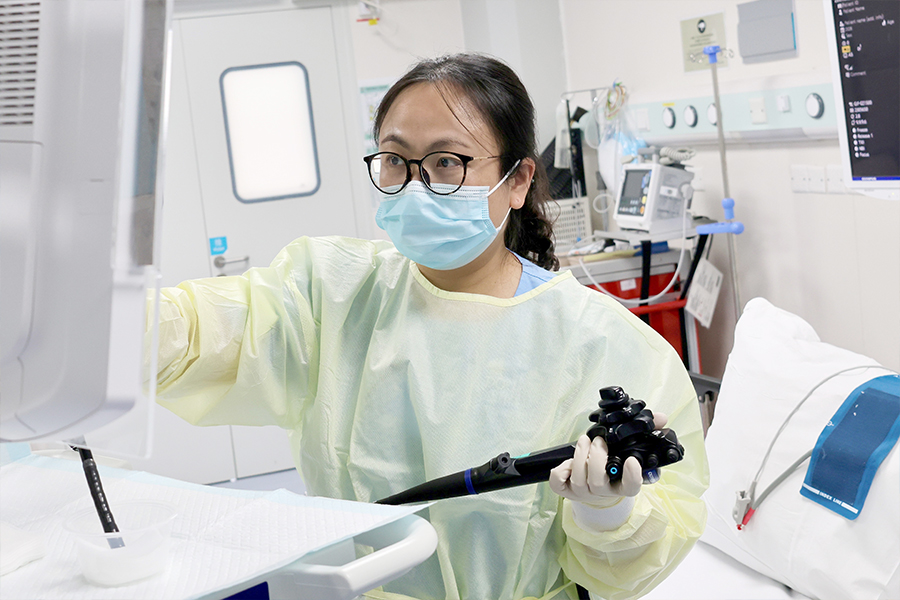 Dr Cai Ming-yan (above photo) is the first doctor from Shanghai to take part in the Shanghai and Hong Kong Healthcare Talents Visiting Programmes, beginning a six-month exchange as New Territories East Cluster Associate Consultant (Endoscopy Centre) in March. She spent two days a week at Central Government-Aided Emergency Hospital (CGAEH) and two days at Prince of Wales Hospital (PWH) to provide endoscopy services and advanced therapeutics endoscopy. Another day she provided colonoscopy services at Alice Ho Miu Ling Nethersole Hospital.
Dr Cai is particularly impressed by the efforts Hong Kong doctors make to provide care and comfort to patients. “After explaining their medical conditions to patients, I also try to comfort them and alleviate their anxiety,” she says. She has begun to learn Cantonese and now often reassures patients with the words: “Don’t worry.”
Hong Kong hospitals have endoscopic medical instruments that have not yet been introduced in the Mainland, which is an advantage, Dr Cai notes. “Observing how local doctors used these new instruments had led to us consider introducing similar equipment in the Mainland,” she says. Dr Cai’s home institution, Zhongshan Hospital Fudan University, has ongoing academic exchanges with PWH. “This personal exchange opportunity at PWH has enabled me to understand how the Hong Kong team collects valuable data and publishes high-quality clinical research,” she explains. Dr Cai hopes to encourage more of her colleagues to seize the opportunity to participate in Hong Kong exchanges. “Visits and exchanges between healthcare professionals from the Mainland and Hong Kong allow for mutual understanding of our healthcare systems, laying the foundations for deeper cooperation in the future in areas such as scientific research. I am very much looking forward to conducting joint clinical studies.”
Learning different approaches to rare diseases
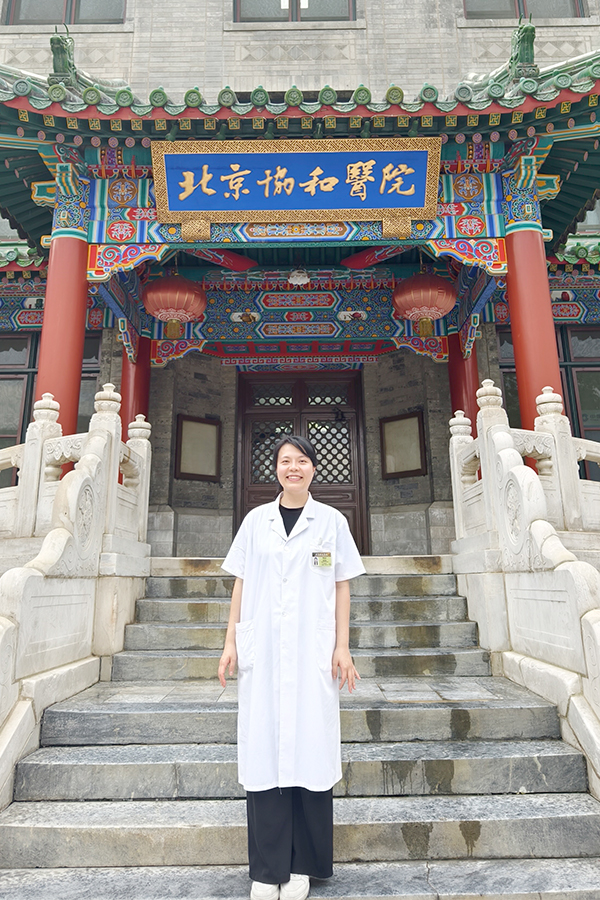 Dr Ng Lun-pei (above photo), Resident Specialist in Neurology of Department of Medicine and Geriatrics at Princess Margaret Hospital went to Beijing for a one-month exchange at the Peking Union Medical College Hospital (PUMCH) in July and found the experience invaluable. “Complex cases from across the Mainland are transferred to PUMCH, doctors accumulate a great deal of clinical experience as a result,” she explains. Since subspecialisation is the major approach in the Mainland, Dr Ng encourages colleagues in subspecialty training to join the exchange programme, especially as some diseases are not commonly seen in Hong Kong.
Hospital Authority and PUMCH signed a five-year collaborative agreement earlier this year, including the training of healthcare professionals and management personnel. Dr Ng’s subspecialty in training is movement disorders and, during her stay in Beijing, she joined the clinic sessions of two professors specialising in Parkinsonism and dystonia. Dr Ng saw patients, discussed their illnesses, and also took part in the deep brain stimulation (DBS) clinic, saw how the specialists run the DBS programming remotely.
The approach at PUMCH is academic and emphasises on subspecialisation, with experts for each condition, Dr Ng assesses. The hospital has about 40 neurologists. Each balancing common diseases while delving into their respective subspecialties. Besides, the disease-specific antibody testing and genetic testing that are undergone by PUMCH and third parties are efficient. The turnover of the former would usually be three days, while for the latter would take around three weeks. It serves as an important reference for some uncommon diseases. And with the sponsorship of research fund, eligible patients are able to undergo latest diagnostic tests and treatments. In Hong Kong, by contrast, training is more comprehensive to treat different outpatients.
Dr Ng says she jumped at the opportunity to join the exchange programme, aiming to learn from experts and explore future collaboration possibilities. “The population is relatively low in Hong Kong and so is the number of patients with rare diseases, and the waiting time for genetic testing is also longer,” she says. “This gave me the chance to interact with many patients with rare diseases, so it was a precious experience.”