High-tech and human touch go hand in hand in patient’s recovery journey
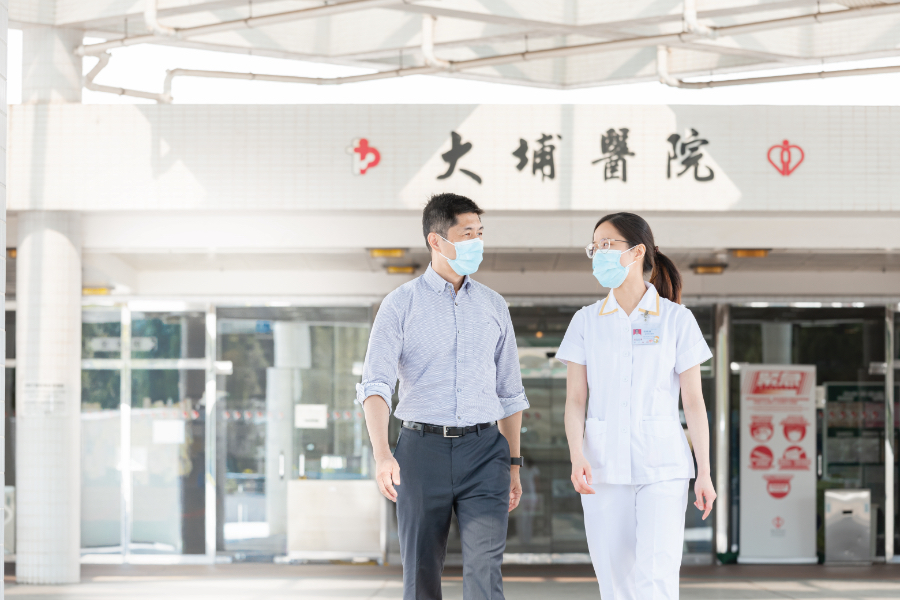
Physiotherapists play a pivotal role in rehabilitation for patients on their recovery journeys. Titanic Lau, Department Manager (Physiotherapy), and Sally Wong, Physiotherapist I of Tai Po Hospital (TPH) reflect on the changes in physiotherapy services over the years, from giving simple exercise instructions to a ‘high-tech and high-touch’ approach.
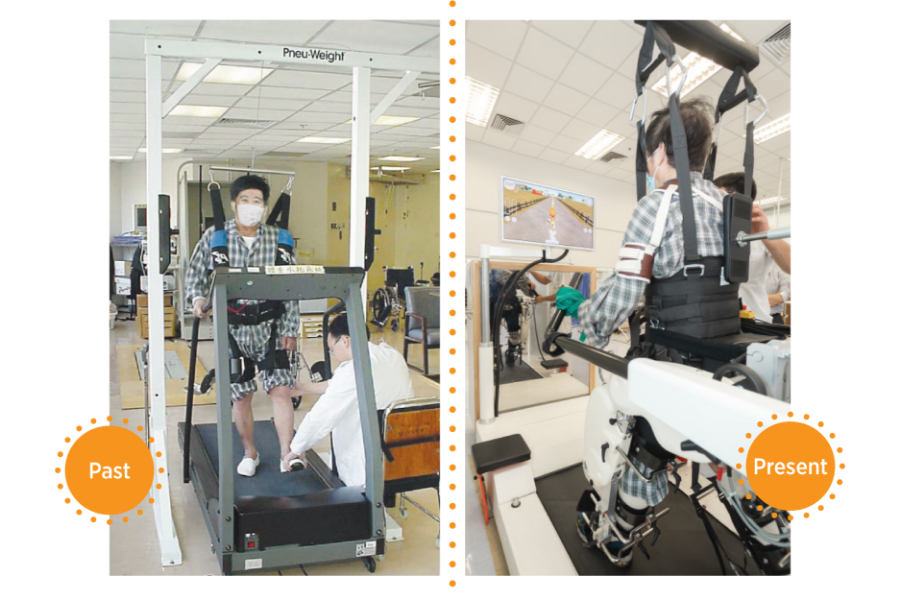
Titanic Lau has been a physiotherapist for 34 years. As his former supervisor reckoned that he is a caring person and encouraged him to stay in public hospital to take care of patients, he then gave up his plan to open a private clinic. He took up his role at TPH in 1998 and helped set up the hospital’s Department of Physiotherapy. Till now, Titanic is still in excellent physical condition – something he attributes to the sheer levels of fitness required when he started out in the job. “Back then, there weren’t many resources or much equipment to help,” he recalls. “We were often required to move patients when they were exercising which took a lot of physical effort.” Titanic jokes that he managed to perform his duties without dropping any patients but says he was soaked in sweat every time he finished a treatment session in old treatment rooms with poor air conditioning.
Rehab exercise as fun as video games
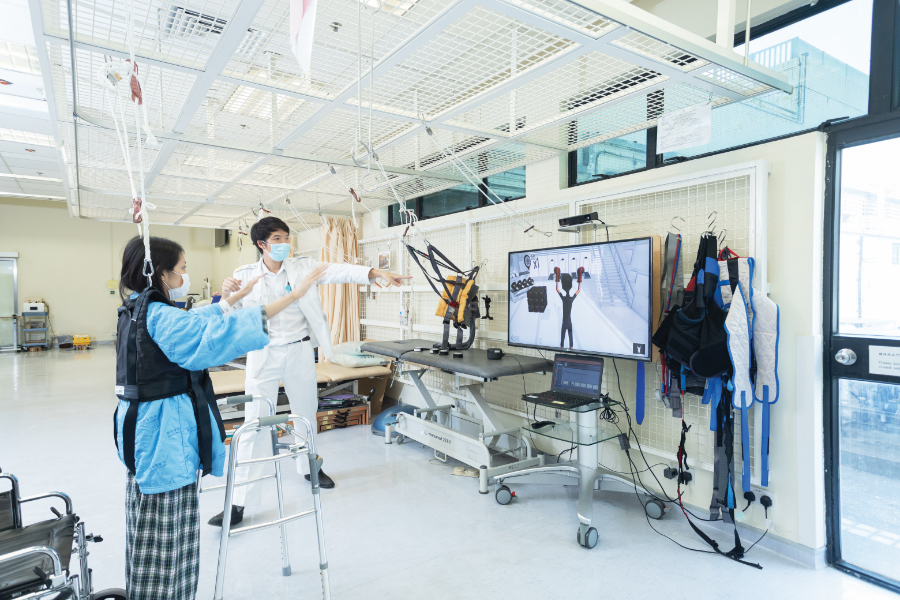
Today, treatment methods and equipment have evolved from simple ones like sandbags and springs to high-tech equipment including a robot-assisted therapy system and fall arrest systems which ensure patient safety.
“The foremost quality Titanic looks for in new members is a caring personality,” says Sally who joined the team eight years ago. “Skills can be taught, so passion and care are more important than academic qualifications. We want our colleagues to treat patients as if they were their family members. Titanic also encourages us to think from multiple perspectives, and to apply diverse skills at work. For instance, we have set up a video team to produce videos that teach patients rehab exercises. Some videos are even uploaded to the HA Go app.” In recent years, the team has used virtual technology in its rehab training. In a virtual reality treadmill walking training, for instance, the videos are shot by team members in wet markets and on hiking trails, so patients feel as if they are exercising outdoors, which makes the training more effective. Elements of video games are incorporated to make balance training more engaging. Patients have to remove obstacles in their way to complete the exercises, making the routines more fun.
“The foremost quality Titanic looks for in new members is a caring personality,” says Sally who joined the team eight years ago. “Skills can be taught, so passion and care are more important than academic qualifications. We want our colleagues to treat patients as if they were their family members. Titanic also encourages us to think from multiple perspectives, and to apply diverse skills at work. For instance, we have set up a video team to produce videos that teach patients rehab exercises. Some videos are even uploaded to the HA Go app.” In recent years, the team has used virtual technology in its rehab training. In a virtual reality treadmill walking training, for instance, the videos are shot by team members in wet markets and on hiking trails, so patients feel as if they are exercising outdoors, which makes the training more effective. Elements of video games are incorporated to make balance training more engaging. Patients have to remove obstacles in their way to complete the exercises, making the routines more fun.
Traffic light at treatment room
New technology is undoubtedly important but Titanic stresses that the human touch cannot be neglected. So his team strives to offer a holistic service. “We not only take care of patients until they are discharged from hospital, but also take a step forward to consider what difficulties they might encounter afterwards. Do they have the ability to go out alone?” These questions drive the team to offer more assessments and training to prepare patients to leave hospital.
“We enhance patient training on muscle strength, endurance, and cardiorespiratory function,” Sally explains. “We even simulate real-life situations. For instance, a traffic light with a real timer is set up to practice crossing the road, which helps patients gain confidence in returning to the community.”
“We enhance patient training on muscle strength, endurance, and cardiorespiratory function,” Sally explains. “We even simulate real-life situations. For instance, a traffic light with a real timer is set up to practice crossing the road, which helps patients gain confidence in returning to the community.”
Re-clustering to foster multidisciplinary collaboration
A multidisciplinary approach to rehabilitation has been adopted in recent years. Titanic observes there was limited communication between specialties before HA reorganised its structures in 2001, bringing specialties together and caring for patients systematically by case management. “Colleagues from different specialties now work and study cases together,” he says. “It improves the effectiveness of the treatment, and helps us provide holistic patient care.”
Colleagues constantly review the effectiveness of treatment. The duo believes that the implementation of electronic health record facilitates big data analysis, which will help reflect patients’ performance instantly and assist therapists to make clinical decisions. Drawing on advances in technology can allow them to take better care of patients’ needs.
Colleagues constantly review the effectiveness of treatment. The duo believes that the implementation of electronic health record facilitates big data analysis, which will help reflect patients’ performance instantly and assist therapists to make clinical decisions. Drawing on advances in technology can allow them to take better care of patients’ needs.